Friday, July 15, 2011

Baazicha-e-atfaal hai duniya mere aage

It is unfortunate that most desi folks listen to gazals without understanding most of the meaning of the words.  Mirza Ghalib wrote at a time (the era of the last mughal emperor, Bahadur Shah) when Urdu poetry was a widely appreciated artform.  Ghalib's urdu is heavily infused with Farsi - which at that time was at its ebb, and had been reduced to the confines of literary circles.

Here is an explanation of this beautiful ghazal by Mirza Ghalib.  Knowing the meaning of the words will help you enjoy the lyrics.


Baazeechaa-e-atfaal hai duniya mere aage
Hota hai shab-o-roz tamaasha mere aage
बाजीचा-ए-अतफ़ाल है दुनिया मेरे आगे
होता है शब्-औ-रोज़ तमाशा मेरे आगे 


 the world in front of my eyes is like a kid’s game.
Day and night I watch its ‘show’

(Baazee – game; Bazeecha – small game; atfaal – juvenile; duniya – world; shab-o-roz – night and day;  tamasha – show)

Ik khel hai aurang-e-sulemaan mere nazdeek
Ik baat hai 'eijaz-e-maseeha mere aage
इक खेल है औरंग-ए-सुलेमान मेरे नज़दीक
एक बात है एजाज़-ए-मसीहा मेरे आगे 


Literal: 
The throne of Solomon (King) is trivial (game:Khel) in my view
The mention of the miracles of the Messiah are idle talk to me.

Figurative:
Power of Kings and miracles of godmen do not impress me

Juz naam naheen soorat-e-aalam mujhe manzoor
Juz waham naheen hastee-e-ashiya mere aage
जुज़ नाम नहीं सूरत-ए-आलम मुझे मंज़ूर
जुज़ वहम नहीं हस्ती-ए-आशियाँ मेरे आगे 

(Juz - without; aalam - creator; hasti-e-aashiya - existence of the world)
Without a name to it, I cannot accept a faceless creator.
To me, the existence of all objects isn’t separate from an illusion

Hota hai nihaan gard mein sehara mere hote
Ghisata hai jabeen khaak pe dariya mere aage
होता है निहाँ गर्द में सहरा मेरे होते
घिसता है ज़बीं ख़ाक पे दरिया मेरे आगे 
(gard- dust; sahra - desert; zabin - forehead; khak - dirt)

 My anguish envelopes the entire desert (??)
The sea smashes its forehead on the sands of the shore (breaking of waves)

Mat pooch ke kya haal hai mera tere peeche
Tu dekh ke kya rang tera mere aagay
मत पूछ के क्या हाल है तेरा मेरे पीछे
तू देख के क्या रंग है तेरा मेरे आगे 

Don’t ask me how I am faring since you left
Instead, focus on your own ways since you left me

Sach kahte ho, khudbeen-o-khud_aaraa na kyon hoon?
baitha hai but-e-aainaa_seemaa mere aage
सच कहते हो खुदबीन और खुदआरा न क्यों हूँ
बैठा है बुत-ए-आइना सीमा मेरे आगे  
(khud-self; been-to see; but-idol; aainaa - mirror; seema - face/image)
Truthfully said, why shouldn't I hold myself with self pride,
My face in my mirror sits like an idol in front of me

Phir dekhiye andaaz-e-gul_afshaani-e-guftaar
Rakh de koee paimaanaa-o-sahba mere aage
फिर देखिये अंदाज़-ए-गुल, अफ्शानी-ए-गुफ्तार
रख दे कोई पैमाना-औ-सहबा मेरे आगे 
(andaaz - style; gul- flower; afshani - effusion; guftaar- conversation; paimana - shot glass; sahba-sheet of paper)
 To appreciate the flowery words and the effusiveness of conversation
Someone needs to place a glass and poetry in front of me
  
Nafrat ka gumaan guzare hai, main rashk se guzaraa
kyonkar kahoon, lo naam na uska mere aage
(Nafrat - hatred; gumaan - emotion; kyonkar - why, after all )
नफरत का गुमान गुज़रे है, मैं रश्क  के गुजरा
क्योंकर कहूं लो नाम न उसका मेरे आगे?

The emotion of hatred is behind me I feel pure
why should I ask you not to take His name in front of me?

Imaan mujhe roke hai jo khinche hai mujhe kufr
Ka'aba mere peeche hai kaleesa mere aage
इमान मुझे रोके है, खींचे है मुझे कुफ्र
काबा मेरे पीछे है, कलीसा मेरे आगे 

(kufra - deviance / temptation; kaaba - Holy place for Muslims;  Kaleesa - Church) 
My conscience holds me back from the attraction to temptations
The Kaaba is behind me and the church in front (of me)

Aashiq hooN, par maashooq farebee hai mera kaam
MajnooN ko bura kehti hai Laila mere aage
आशिक हूँ पर माशूक फरेबी है मेरा काम
मजनूँ को बुरा कहती है लैला मेरे आगे 
(Aashik - lover; mashook - person who is the loved; farebi - cheating)

I am the Lover, yet, my dear, I am full of deceit
For this reason every Laila condems (calls names) Majnu

Khush hote hain par wasl mein yoon mar naheen jaate
Aayee shab-e-hijaraaN ki tamanna mere aage
खुश होते हैं मगर वस्ल में यूं मर नहीं जाते 
आई शब्-ए-हिज्र की तमन्ना मेरे आगे
(wasl - reality; shab - night; hijra - departure; tamanna - wish/desire) 

 I become joyous but not to the extent of dying from joy
The wish for separation (the night of departure) has surfaced in my heart

Hai mauj_zan ik qulzum-e-KHooN, kaash, yahee ho
Aata hai abhee dekhiye kya-kya mere aage

I wish this is going to be that wave of blood
Let’s see what lies ahead of me now.

Go haath ko jumbish naheeN aaNkhoN meiN to dam hai
Rehne do abhee saaGar-o-meena mere aage

Say my hands lack motion, but at least my eyes have strength
For now, leave the wine and glass in front of me

Ham_pesha-o-ham_masharb hamraaz hai mera
'GHalib' ko bura kyoN kaho achchaa mere aage!

My colleague and my fellow drinker is my friend
If you feel Ghalib is bad, why do you call him ‘good’ when he is around?


English Translation by Rakesh Chaubey

Friday, June 3, 2011

High Achievers

'Dharma' and 'Karma' are two words that are used in the West in contexts that are totally different from the original meanings of these words.  Let's talk about another word - 'Sanskar'.  Sanskar is the value system that passes down in a family. If you are a responsible, moral, hardworking person who values education who stays committed to his/her family, then you have 'good sanskars'.  Your kids will learn from you and carry on this torch.  Do good sanskars give a people an edge?  Lets take the National Spelling Bee as our test tube case - because this competition is free of influences of discrimination and social engineering.

You can look at the results of the past years and see that the Indian community has produced champions year after year.  Where do these kids end up?  Do they reach heights of glory in their professional life or do they keep bumping their heads against the glass ceiling before resigning and joining a 'pooja group'?  Well, that is for you to mull over.  One thing we know for sure, Indians start out as high achievers (the proof is on the left).  If, despite all their capability,  they do not reach decision making positions in society from where they can shatter the glass ceiling for others, then it is due to something they lack - then it is their unwillingness / inability to hold hands across linguistic and regional lines and form a singular identity and work as a team.

Didn't someone say, "I went to India. I met a Gujarati, a kashmiri, a Punjabi,  a Bihari, a Marathi... but I never met an Indian"

Wednesday, May 19, 2010

Meet a Monster...

Terrorists have always been galvanized into action by poisonous words from sections of the so called Islamic clerics. These are monsters. Let Towercam introduce you to one today....

"So you go to India, and if you see a Hindu walking down the road you are allowed to kill him and take his money, is that clear?"

"Nuclear power stations could be fueled with the bodies of Hindus"

 "Jews, should be killed as by Hitler.  Fly into Israel and do whatever you can. If you die, you are up in paradise. How do you fight a Jew? You kill a Jew. In the case of Hindus, by bombing their businesses."


Thursday, May 13, 2010

Thursday, May 6, 2010

Music that soothes the soul

For those of you who don't know this already, the music group "Indian Ocean" has gained a lot of popularity in Hindustan over the past few years.  I came to learn about them yesterday from a good friend.  Towercam focuses your attention to this music.  Lend it your ears and comment if you please

Click here to enjoy the music of "Indian Ocean"

and if you want to know more about this group Click here

Wednesday, May 5, 2010

Hawking on SETI

.

It is only natural for people to expect pearls of wisdom from the minds of brilliant people. When Stephen Hawking recently made a statement that the endeavor to seek out alien intelligence from outer space is an unwise strategy, a lot of people reacted angrily – after all a scientific mind was expected to be curious and investigative – and here was, an acclaimed genius, going the opposite way. Many wondered if he had a bad dream after watching ‘Avatar’!

Monday, April 19, 2010

Movie Review

Hello Hum Lallan Bol Rahe hain ****


Living true to the adage that "Every dark cloud has a silver lining", this silver lining of a movie emerges out of the darkness of  the recent clashes between Mumbaikars of Marthi and non-Marathi origins.  It is wonderful to see efforts to bridge this artificial divide between people of the Mumbai Metroplex who share a common destiny as Mumbaikars - no matter what accent they may have.

Lallan Prasad Prajapati (played by Ram Pal Yadav) is a security guard with a private security company.  He is waiting for his lot to improve before he can approach a girl in his home town of Bijapur, who he loves secretly.  Lallan and his mentor, Tiwari ji are very down-to-earth practical people.  The viewer empathizes with Lallan and comes to realize that however hard the rotten eggs of Shiv sena try, they can't tear asunder the heart of Mumbai - which has already melted in the melting pot of cultures. The viewer realizes that it is India that has been depicted in the test tube of Mumbai.  The movie is highly recommended for every NRI family, as it gives a very much needed message - to see us all as one people despite our diversity. Whether it be Gujarati Hansa ben, Lallan, the bhaiyaa, or Punjabi Sharmaji, they are all us!  NRI's, despite their high level of education, could very well take this valuable lesson away from this movie.

This is a light hearted movie, with good humor.  It is a very clean family movie -  and these days I allow three stars for that reason alone.  This movie is very enjoyable.  The depiction of our value system rooted in good ol' traditional Indian culture is wonderful.  Watch this movie with the whole family. It is really nice!

Sunday, April 18, 2010

What a layman should know about Guns


It really does not matter whether the reader opposes or supports gun control.  In either case, there are some things that we all should know about guns – even as lay men.  I hope you find this article informative and enjoyable.

Guns are not toys
Guns are devices that throw out pieces of lead at supersonic speeds.  Guns may, in certain cases, be small, but they are not toys and should be kept locked and away from where children can reach them.  People, who feel that they lose their temper when angry, should also not keep guns.

Types of Guns.
First, there are long guns and there are short guns.  The long guns can either be a rifle or a shotgun or be a combination with one rifle barrel and one shotgun barrel.  The difference between a rifle and a gun is primarily in the barrel. 

The rifle barrel (see image on left) has long spiral grooves cut on the inside that spins the bullet.  For this reason, the bullet from the rifle is more accurate. Rifles can have a variety of bore sizes. 

The shotgun has a smooth tube-like bore and is usually utilized to shoot either a slug or a few small shots that shower the target.

Among the long guns, rifles are used for hunting and target practice, while shotguns are used for self defense or recreationally, for shooting skeet.

The handguns can either be revolvers or pistols.

There is a further classification based on the way a rifle / gun is loaded.  There is the single shot, double barreled, bolt action, lever action, pump action, semi automatic and fully automatic guns.   The fully automatic guns are banned in America.

The rules and  protocols of handling / owning guns
Rule 1.             Treat every gun as if it is loaded. Never point a gun at anyone.
Rule 2.             Never keep your finger on the trigger. 
Rule 3.             Check to see the gun is unloaded before handing it to anyone – even if you know that the gun is unloaded.
Rule 4.             Never keep a round in the firing chamber.
Rule 5.             Always use a trigger lock for rifle and guns and always keep handguns in a safe.
Rule 6.             Always keep the safety lever in the ‘safe’ position.
Rule 7.             Educate your family about these rules
Rule 8              Never keep a gun around if someone is emotionally / mentally unstable or loses his/her temper when angry.
Rule 9.             If you are a kid and see another kid with a gun, quickly put as much distance you can put between yourself and him and go tell the nearest adult you can find.

If you have kids with a thoughtful and serious temperament who are able to comprehend that the gun is a lethal weapon, it is best to teach them gun safety.  It is a good opportunity to explain that the way gun-handling is shown in the movies is not the way guns are handled in real life.  There is nothing very ‘manly’ or ‘romantic’ about them.

Once you present them with the safety rules and once they see you observing the protocols in handling the weapons, it immediately sinks in their minds that handling guns is a serious matter and they understand that the lock on the trigger is to be respected.  You must let them handle unloaded guns in a safe way and make them observe all the rules pertaining to the safe handling of guns.  Once they hold the gun their curiosity is quenched and a lot of their misconceptions get cleared.  First they wonder that if the gun is so heavy, how does Bobby Deol or Bruce Willis fire them while in mid jump with the gun held sideways in a horizontal position?!

Movies and Video games have done a lot of disservice to mankind by portraying guns as casual symbols of manliness or valor.  When you have bought ammo a few times, you realize that, as expensive as ammo really is, the rapid fire on the screen is either virtual fire of a videogame or taxpayer paid ammo being expended by the military.

Most people own guns for target shooting or hunting.  Guns are also deterrents to crime.  People don’t go harassing others in Texas because of the ‘conceal and carry’ law which lets you carry a gun concealed on your person - if you have had training in handling the gun, are familiar with the laws and have had a background check.  Guns have no doubt been abused by stupid and psychotic people, but if that excuse is used to yank the gun out of the hand of the law abiding citizen, then one must remember - the only segment of the society that will still be armed will be the crooks and the police – and the police can’t be everywhere all the time.

Friday, April 16, 2010

At the confluence of Cultues

A lot of funny eddies are created when streams of two different cultures meet at a confluence. Here is a real life experience of a friend of mine

A friend of mine, who hails from Iran, belongs to the generation of Iranians who were studying in the US when the Iranian revolution took place.  Most of these students found monetary support yanked due to the uprising and had to fend for themselves in America.  Many were forced to work hard to finance their education.  My friend recalls how he and some of his other Iranian friends drove taxi cabs in the Washington DC area for a shiny nickel.
He recounts a very funny incident when he, along with a few of his Iranian friends, was sitting 'benched' at a Taxi Cab dispatch center waiting to be called.  The dispatcher, a black guy, was partial and kept them waiting while he kept giving dispatches to  his own friends.  Now we know that in our part of the world, an insult to a man's wife is taken as a direct attack on a his honor- and is considered to be 'extreme provocation'  for which proverbial "khoon ki nadiyan" often flow.  The same is true for Persians.  Finally out of frustration, one of the Iranian guys, made a vulgar snide remark about the dispatcher's wife in Farsi.

 The dispatcher asked one of the other Iranian guys, "Hey, what did he just say ?".

In an attempt to get his friend in some hot water, his friend jokingly translated the remark ad verbatim into English.

At that, the dispatchers face lit up.

He smiled and said, "Hey! you want her man?!!! Take her !  I am tired of her big fat *** anyways.  You can have her, brother.  I am looking for a way to get rid of her.  You want her phone number ?"

Everyone broke out in laughing.  One of the guys quipped back..... "Well, you know what Joe, I might just think about it, but first you have got to give me a dispatch!"

Wednesday, April 14, 2010

Is Towercam a Wild Goose Chase?

.

By bringing you Towercam without any strings attached or without any vested interest I have surely puzzled a lot of my readers. I talk to a lot of you as family and friends and I get feedback (I haven’t gotten a written one formally so far, I’ll admit). I am unaware of how many people are reading forwarded copies of the Towercam. Do I care? No. I don’t.


The reasons I decided to start Towercam were several. I felt I could write well enough to hold peoples’ interest. One impediment was out of the way. Now many can write well, but of all why me? Well, because my experience of life has taught me that there is a human need – at the very top of Maslow’s pyramid of human needs – and that is the need for ‘Self actualization’. Per Maslow, when one’s basic, emotional and security needs are satisfied, one feels the need to make one feel, “happy for his deeds”. I am not, for a moment, alluding that all my needs lower down in the pyramid of needs have been fully met. They have somewhat been met, and I filled the voids that remained with contentment. As you age, contentment comes easier and easier – mainly because of your inability to change the status quo you accept the ‘cruising altitude’. I could go hankering my remaining years increasing my cruising altitude, but heck, I have a lot of ground to cover and a lot of lovely vistas to enjoy. Flapping wings hard messes all that up. So, one has to spread the wings like and eagle and soar…

I find writing to every one of my family and friends on a frequent enough basis is quite an impossible chore. For that reason, months used to go by without any contact. Now with Towercam, you all know regularly enough what is going on at my end, what movies I liked and what has been giving me joy – or been tormenting me!

I feel it is important to pass on the cultural torch to the next generation so that they grow up aware of their cultural wealth and traditions. If a young person grows up firmly planted in his culture, he carries on the values. And while I root for heritage, I like to weed out the evil / stupid beliefs / rituals in our socio-cultural system, because I feel that the ‘free format’ structure of our philosophy has allowed a lot of con-men to infect it with mindless rites, superstitions and rituals, that like viruses in a computer system, just take over and proliferate. While scientists like Carl Sagan and Jack Oppenheimer could peel the layer of filth and see the truth of our philosophical system, most of the world still labels us as the way many of us have projected our image – as savage slum-dogs. Are we that? I don’t think so.  Towercam always aims at peeling the filth off our philosophical core – most of which has accumulated during the age of ignorance when wars were waged against Hindus – just to kill them for a place in heaven, and in turn the Hindus raised the pitch of their fervent prayers so that a divine force would destroy the attackers. Well, history tells us otherwise. I want the generations to succeed us to be more united in order to defend themselves and demand their rightful plate of gruel at the table, more proud, in order to hand over the torch to the generation that will follow them and more rational and humble to understand the larger picture of life and find their place in it.

So, really, that’s what the Towercam is all about. I will still write, even if no one reads it. Coming to work, riding by myself, I often like to sing. No one hears it but me. It makes me happy. So I sing. For similar reasons Towercam comes to you.

Sunday, April 11, 2010

Why Towercam ?

The Towercam is a no-profit community building effort. The idea is to increase awareness of current events, the lessons from our history which were never taught in school, share tips and ideas so that a discourse gets started and our community is strengthened and starts seeking to participate and assert itself in the political processes of the lands we live in. We want a piece of the pie and we shall have to learn to stand up and be noticed. Share Towercam with other community members. It is a win win for all of us.

 
Please feel free to send your comments as to how you think the end of community building can be better achieved.

Wednesday, March 31, 2010

Scripture and its mindless acceptance


.


The unquestioning reverence to scripture permeates all faiths of the world.  Even some of the educated among us hold the archaic scriptures above logic and reason.  It must be noted that the word ‘educated’, not ‘enlightened’, has been used here.  How adherent a person is depends largely upon his or her upbringing.  Many so called educated people engage in eloquent and emotionally charged discussions on the interpretation of the scriptures.  Many twist these interpretations to their convenience – and many-a-times use scriptures to justify their acts of cruelty and greed.

The crusades launched by the Christians against the Muslims were a ‘holy’ war.  The massacre of the Persians by the Imam Omar was also a ‘holy’ war.  Years later, the great grandchildren of these very Persians who had accepted Islam under threat of the sword, went eastward into Hindustan killing ‘ in supposedly holy wars, because in the words of those who killed in name of Islam, one had to kill ‘infidels’ to become a ‘Ghazi’.  They were completely blinded by the ‘sanction’ of the scriptures that completely over-rode one of the most basic attributes of human intelligence – their conscience.  This is apparent from their ‘journal entries’ that they left behind – detailing how systematically and without any inkling of guilt, they killed thousands and looted, raped and plundered simply because, according to their interpretation of their holy book, it was okay to kill ‘kaffirs’ (infidels) and take their property.  Today the great grandchildren of those very ‘infidels’ who were raped and looted and forced to ‘convert’, are hell bent on trying to change the secular nature of India and impose Sharia law.   The Buddhist and Hindu past of Afghanistan has almost completely been erased from the consciousness of most people.  The Spanish Conquistadors who brought Christianity to South America also indulged in massacres of the natives – justifying their acts by the claim that the Natives who died at the hands of Christians would be spared the fires of Hell.  So, in fact, the Conqistadors claimed that they were doing a favor to the natives by killing them!  In Hinduism too, the people of the Asur tribe, if killed at the hands of Rama were considered to be earning a passage to heaven!

Coming to modern times, the reference to the invasion of Iraq as a ‘crusade’ by George Bush, (the 43rd, and arguably one of the worst Presidents in US history), brought frowns from many quarters.   When the operations began in Iraq, word leaked out that a few free lance evangelists were managing to get ‘embedded’ with the army units and were out proselytizing. Immediately the army distanced itself and the matter dropped below the radar.  The penchant of the 43rd, who claimed to get his instructions from God, is well documented.

Most of these people take the scripture to be the ultimate truth.  Some believe it to be the word of God – brought to them through the prophet.  Rational people know that these were written by people who lived at a time when there was no electricity, anesthesia or the internet.  Smart among their peers, they were still knuckle scrapers and buffoons by today’s standards – because human knowledge hadn’t progressed as far as it has done today.  Some ranted the visions they saw through their minds impaired by drugs or hobbled by superstition.

We should not let the scripture over-ride our commonsense.  Any and every belief must first be filtered through minds shaped by scientific knowledge and rational thought.

Sunday, March 28, 2010

Hindus – Treacherous, Indolent and Spiritless ?

.

Over the last century we have seen Greater India (a.k.a Hindustan) lose territory to Pakistan - some of which later became Bangladesh.  Hindus have practically all been chased out of Kashmir a few years ago.

The Account of the Wandhama Massacre in Kashmir

 The population of Muslims has risen much faster than other religious groups since partition.  Now pockets of hardcore Islam are springing up all over India, and regions of the country that have a concentration of Muslim population are asking for statehood.  Telangana is a recent example

As the Indian Government investigates Narendra Modi, a more basic question must be asked –Will Hindus ultimately concede all the territory piece by piece to Islam and ultimately convert?  Are they working to ensure their survival or are they resigned to fate on this issue? Are they just tied up with superstitious rituals and busy coddling to thousands of Godmen, astrologers, and Swamis? Some may laugh of this extrapolation, but in the minds of some more enlightened readers, this might find some traction.  The History books of India do not talk about the massacre of the Hindu populace by Muslim invaders from Taimur lang to Nadir Shah. Do we know that at the end of a each day of the thirteen days of massacre (Kalt-e-aam) Nadir Shah's fist had to be soaked in warm water to dissolve the congealed blood - so that his fingers could stretch open and release the sword?  I did not know it myself, but an Iranian colleague told me that he had learnt about this in history class - in Iran!  Is it really true?  I do not know!  For political correctness and due to their inherent pacifist and cowardly nature of most Hindus, history, as it is taught, has been sanitized by taking out the horrendous accounts of these massacres that have largely been written by the personal historians of these invaders.

Do Hindus lack ‘gairat’ (pride) because they do not know their history and couldn’t be bothered enough to learn about it?  You decide.  Most Hindus condemn the fundamental and intolerant nature of Islam but fail to look at their own faith system and root out its weaknesses.  The whole idea here is to hold a mirror to Hinduism's face - so that Hindus can see what is wrong with some aspects of their belief system and problems with the way their faith is practiced.

Here is a page from history so that you can make up your mind.  So, here we go...


"The Gates of Somnauth"

A SPEECH DELIVERED IN THE HOUSE OF COMMONS ON THE 9TH OF MARCH 1843 BY THOMAS BABINGTON MCCAULAY, SECRETARY OF CONTROL, BRITISH GOVERNMENT

"Her Majesty is the ruler of a larger heathen population than the world ever saw collected under the sceptre of a Christian sovereign since the days of the Emperor Theodosius. What the conduct of rulers in such circumstances ought to be is one of the most important moral questions, one of the most important political questions, that it is possible to conceive. There are subject to the British rule in Asia a hundred millions of people who do not profess the Christian faith. The Mahometans are a minority: but their importance is much more than proportioned to their number: for they are an united, a zealous, an ambitious, a warlike class.

The great majority of the population of India consists of idolaters, blindly attached to doctrines and rites which, considered merely with reference to the temporal interests of mankind, are in the highest degree pernicious. In no part of the world has a religion ever existed more unfavourable to the moral and intellectual health of our race.


The Brahminical mythology is so absurd that it necessarily debases every mind which receives it as truth; and with this absurd mythology is bound up an absurd system of physics, an absurd geography, an absurd astronomy. Nor is this form of Paganism more favourable to art than to science. Through the whole Hindoo Pantheon you will look in vain for anything resembling those beautiful and majestic forms which stood in the shrines of ancient Greece. All is hideous, and grotesque, and ignoble. As this superstition is of all superstitions the most irrational, and of all superstitions the most inelegant, so is it of all superstitions the most immoral. Emblems of vice are objects of public worship. Acts of vice are acts of public worship. The courtesans are as much a part of the establishment of the temple, as much ministers of the god, as the priests. Crimes against life, crimes against property, are not only permitted but enjoined by this odious theology. But for our interference human victims would still be offered to the Ganges, and the widow would still be laid on the pile with the corpse of her husband, and burned alive by her own children.
 It is by the command and under the especial protection of one of the most powerful goddesses that the Thugs join themselves to the unsuspecting traveller, make friends with him, slip the noose round his neck, plunge their knives in his eyes, hide him in the earth, and divide his money and baggage. I have read many examinations of Thugs; and I particularly remember an altercation which took place between two of those wretches in the presence of an English officer. One Thug reproached the other for having been so irreligious as to spare the life of a traveller when the omens indicated that their patroness required a victim. "How could you let him go? How can you expect the goddess to protect us if you disobey her commands? That is one of your North country heresies."

Monday, March 15, 2010

Festivals of Spring and our common roots


Holi  - Feb. 28, 2010 (day of the Full Moon)
Charshamba Suri - Wednesday, March 17
Easter - April 4, 2010
Lohri - January 13, 2010

The descendents of the people who originally dispersed from central Asia are today spread over large swathes of the globe.  They are spread over India, Pakistan, Afghanistan, Iran, Tazikistan, Turkey Armenia and most of Europe. 

Since the original settlements sprang up in the Turkey / Armenia region and the dispersion began around 13,000 BC, religions have sprung up over time and have painted these descendents in various hues of religious belief.  Changes over time, interaction with new cultures and diverging lingual branches have made it very difficult for these descendents to see the common thread that runs through them.  After all, what can be common between an Armenian Christian, an Indian Sikh, an Iranian Muslim and an Indian Hindu?!  It seems there is a lot common among them than each realizes.


The Hindus have done celebrating Holi a few weeks ago, the Muslims and Christians are going to be celebrating Nau Roz and Easter soon.  The Sikhs have done celebrating Lohri in January. Now is there a common thread here?  Yes!  There is!

As the Hunter gatherers of Central Aisa settled down and took up agriculture, and as their numbers increased from  groups of  8-10 (at the time they were hunters) to the few hundred in a village, there was a need for each family unit to have their own hearth.  Instead of each family having to start fires to cook everyday, it was found convenient to have a communal fire that was kept burning round the clock.  Every evening the inhabitants of the village would bring the fire from this communal fire to their hearths to cook their food.

The fire was the savior. It cooked their food, provided them security at night.  When the sun went down, the fire was there as its ambassador to provide light and warmth.  The darkness was the evil unknown. It was fear and death.  The fire was light.  It was enlightenment. It cut the darkness and allowed people to see.  It was only natural for them to hold the fire with the sentiment of reverence.  Many descendents of these people miss out on the reason for their ancestors’ reverence for fire and use terms like “fire worshippers”, “Atesh parast” etc. in demonstration both, of their lack of knowledge and biases ingrained by their religious edicts.

Coming Wednesday (March 17) marks the festival of ‘Charshamba Suri’.  It is a festival that is observed in Iran and Afghanistan, to the detriment of the Mullahs and the fanatics who still seek Arab dominance over their Persian Heritage.

Charshamba Suri, is probably the original festival from which Holi of the Hindus and Easter of the Christians spun off from.  Charshamba means Wednesday in Farsi. Suri means Sun. In Sanskrit, Sun is called Surya. Suri is a widely found last name in India as well.  Celebrated by both the Muslims and the Zoroastrians, Charshamba Suri is the Sun festival that is celebrated on the Wednesday before the Vernal Equinox.  In essence, it is a Spring festival that rejoices the end of winter and the arrival of the ‘growing season’.  Bonfires are lit (probably a tradition rooted in the fact that there was a lot of farm waste that needed to be burned off at the beginning of spring).  People jump over the bonfires and shout, “Give me your redness of health, oh fire; and take away my paleness of ill health”

Charshamba Suri marks the beginning of ‘New Year’ called Noruz.  The celebrations last a couple of weeks.  Every family lays out a spread with dry fruits and munchies on it.  People visit friends and relatives and partake of these munchies.  This festival is observed in Iran and Afghanistan.


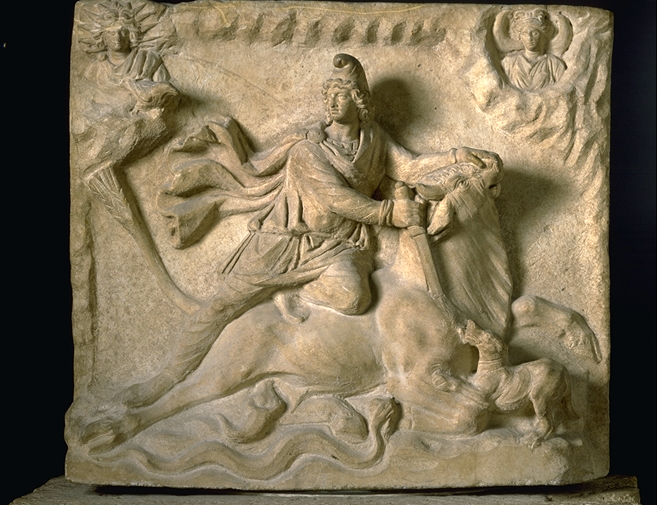
Image of Mithra (symbolizing the Sun) slaying the bull
Roman tablet.

In India, the  original prople brought the reverence to the sun with them – and it shows in the frequent mention of ‘Mithra’or 'the sun' in the Rig Veda. This is the oldest of the four Vedas and is believed to have been written a few generations after the  settlers crossed the Khyber. To this day, last names like Mishra, Mehra, Mitra - all variants of Mithra are widely found in India.  We will talk about the prevalence of Mithraism in ancient Rome a little bit later. 

The Aryan settlers who came into the Indian subcontinent saw the indigenous people (possibly the descendents of the first evolutionary migration through India) worshiping fierce looking figures and called them ‘div’ – their word for a malevolent supernatural being that was revered and feared.  Later as they adopted these deities as their own, the reverence to Mithra dropped away in favor to these deities  (primarily Shiva) and “div” became “deva”  - a term that had, by then, lost its original malevolent connotations.  Somehow, in all this mixing, the celebration of  Spring remained intact. 

The concept of throwing colored water on each other during Holi is a variant of the festival of Vartavar / Verdevar in Armenia where people throw rose water on one another. During the day of Vardevar, people of all ages are allowed to douse strangers with water. It is common to see people pouring buckets of water from balconies on unsuspecting people walking below them. The festival is very popular among children as it is one day where they can get away with pulling pranks. This is so remarkably similar to the festivities during Holi!


Water Festival (Vardevar) in Aremnia

The festival of Holi in India
The concept of the bonfire has remained with us till today.  Till a few years ago, people would get the fire from the bonfire to cook a symbolic meals like their ancestors did millennia ago on the  plains of  Armenia and Turkey.  Akin to Charshamba suri, Holi is a festival of social flurry.  Sweets, and munchies are served to visiting family and friends. The Sikhs of India have a big bonfire for Lohri as well, and each person has to walk up to the fire and reveal something to all assembled with fire as the witness to the person's assertion.


The Romans, much like their Indian brethren who had crossed the Khyber Pass into India also celebrated Mithra.  In fact, the Romans had the most elaborate Mithraic temples.  The Roman empire stayed steadfast in its endorsement of Mithraism until, towards its decline, when Emperor Constantin adopted Christianity as his official state religion and the Mithraic priests - who ironically live in the Vatican today, simply made substitutions in their books, replacing Mithra with Jesus, and started calling themselves Christians. Most the Christian traditions, easter, the decorated tree, the resurrection etc. are, in essence, Mithraic.  Mithra lived on in Jesus. 

In Armenia, the Christian priests could not prevent the people from celebrating the Spring with bonfires.  Unable to control this tradition, they invited the people to light their bonfires inside the church-yards.  Over time, the lighting of Bonfires was replaced by lighting of candles - inside the Church.  Even today some traditional Christians from Armenia light candles at church on Easter and carry the flame home to cook their meals and bless their dwellings.

The PIE (Proto Indo-Eruopean) language tree
Startling linguistic evidence of common origins
(Click on image to enlarge)

If national boundaries and religious differences are ignored, a lot of people in this world are bound together in the culture of a common tribe of the PIE tree.  These are the people whose languages can be found on the Proto Indo European Language (PIE) Tree (figure above).  It is one big tribe that should bridge language barriers, ignore the holy men,  and learn about one another.

(The illustrations and graphics accompanying this article are from external sources. Author does not claim credit for these works)